
Your Security Tools Are Working — But Is Anyone Watching Them?


At 10:14 a.m., a security platform blocks a workstation from reaching a suspicious domain.
Nothing happens. No systems go offline. No employee calls IT. From the business's perspective, it is an ordinary Tuesday.
Twelve minutes later, the firewall blocks an unusual outbound connection from the same computer. Later that day, unusual authentication activity is recorded for the same user's cloud account.
Three security controls have now done exactly what they were designed to do.
But each may only see its part of the story.
Who determines whether those events are related?
More Visibility Doesn't Always Mean More Awareness
Businesses have more security visibility than ever.
Firewalls inspect network traffic. Endpoint protection monitors computers. DNS security evaluates where devices are trying to connect. Microsoft 365 can generate identity and cloud security signals. Email security examines incoming messages.
Each provides another layer of protection—and another source of information.
The challenge is that security incidents rarely stay inside one system.
A blocked domain could be caused by an advertisement or legitimate application. An unusual network connection might be normal software behavior. An unfamiliar cloud login could simply be an employee working somewhere new.
Individually, none of those events may be particularly concerning.
But when several involve the same user or device within a short period, the context changes.
The security challenge is no longer simply detecting events.
It is understanding what they mean together.

“Blocked” Doesn't Always Mean “Resolved”
Words such as Blocked, Prevented, Denied, and Quarantined are reassuring because they tell us a security control responded successfully.
But they do not necessarily explain why the activity occurred.
If a workstation repeatedly attempts to reach a suspicious destination, blocking the connection protects the network. The next question should be why the computer keeps trying.
Maybe legitimate software is responsible.
Maybe an old application is still running.
Maybe there is an unwanted browser extension.
Or perhaps the activity deserves a deeper investigation.
The objective is not to assume every alert represents an attack. That creates noise and eventually makes meaningful alerts easier to ignore.
The objective is to determine which events can be safely closed and which require action.
The Gap Between the Dashboards
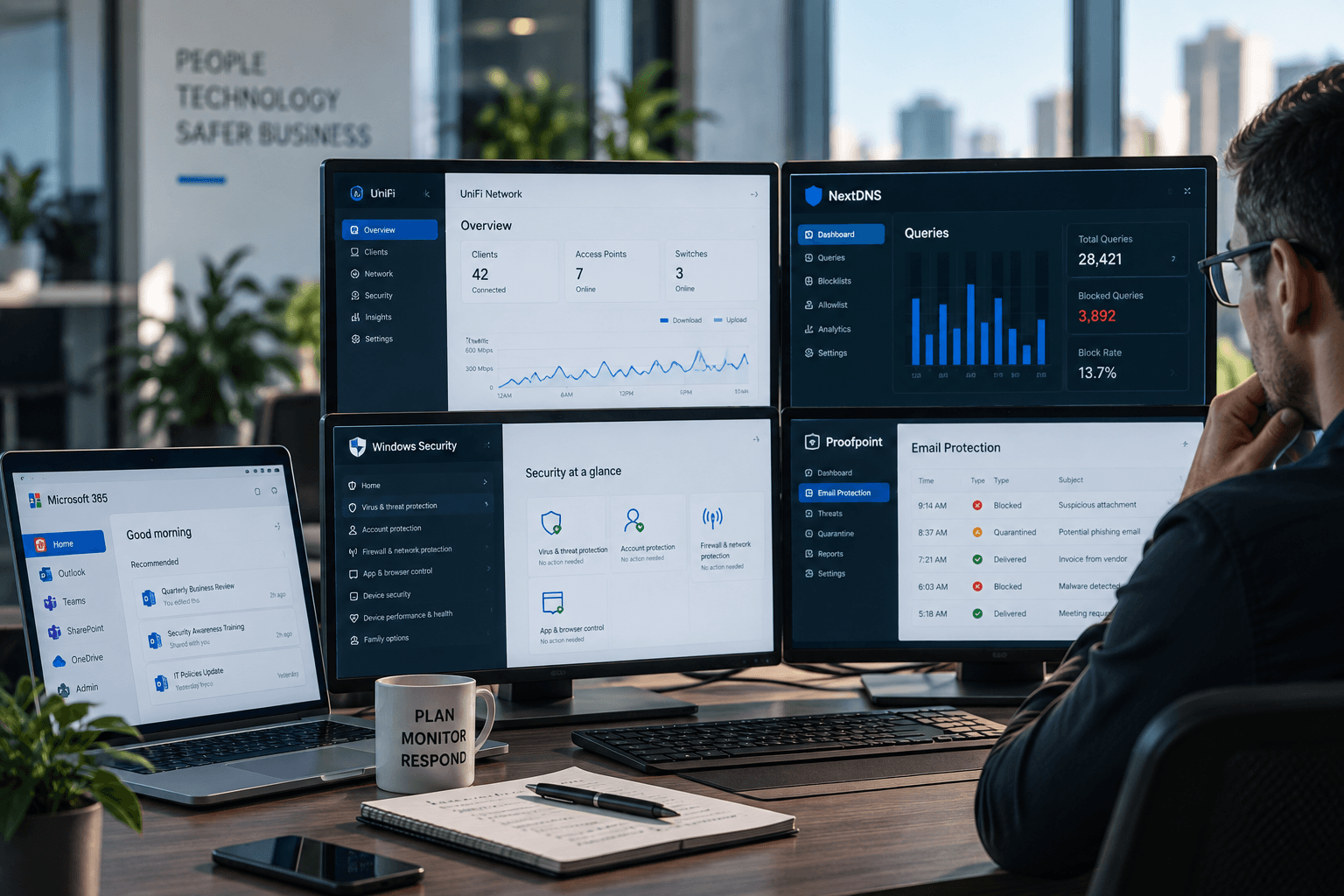
A business may rely on separate platforms for network security, endpoints, cloud services, email, and other parts of its environment.
Individually, those systems can work extremely well.
But an important security event may not appear as one obvious critical warning.
It might appear as several ordinary events scattered across different dashboards.
That creates an operational problem.
Adding another security product does not necessarily solve it. In some cases, it simply creates another place to look.
The missing layer may not be another tool.
It may be someone responsible for understanding what the existing tools are already seeing.
From Security Tools to Security Operations
This is where security operations become different from simply deploying cybersecurity technology.
When a meaningful event appears, someone needs to review what happened, determine whether other systems saw related activity, investigate anything unusual, document the findings, and escalate when action is required.
Sometimes that investigation concludes:
Legitimate activity. No further action required.
That is still a valuable outcome because uncertainty has been replaced with an answer.
Other times, the same process might uncover unauthorized software, exposed credentials, a configuration problem, or activity requiring immediate intervention.
Larger organizations may have internal security teams performing these functions.
For smaller and midsized businesses without dedicated security personnel, a Managed Security Service Provider (MSSP) can provide that operational oversight.
The goal is not to react to everything.
It is to know what deserves a reaction.

Who Owns What Happens Next?
Cybersecurity investment is often measured by what has been deployed.
Do we have a firewall? Endpoint protection? MFA? DNS filtering? Email security?
Those controls matter. No single one is the answer; each contributes another layer of protection.
But there is another question businesses should be asking:
What happens when those systems start telling us something?
A company can have strong security technology and still have a gap if alerts are rarely reviewed, related activity goes unnoticed, recurring events are not investigated, or nobody clearly owns the response.
The next improvement in cybersecurity may not require another product.
It may require getting more value from the security controls already in place.
Because the most important security event may not arrive as one enormous red warning.
It may arrive as three ordinary signals that only become important when someone realizes they belong together.
Your security tools may already be watching your business.
The question is: who is watching them?