
Your Business Has a Firewall — But Is It Actually Protecting You?


Having a firewall is one of the basic requirements of business network security. It sits between your network and the internet, inspecting traffic and deciding what should be allowed or blocked.
So, if your business has a firewall, you're protected. Right?
Not necessarily.
A firewall can be online, updated, and functioning exactly as configured while still allowing traffic that no longer needs to be allowed. And even a perfectly configured firewall cannot protect a business from every cybersecurity threat.
The better question isn't simply whether you have a firewall.
It's what that firewall allows, how it's being managed, and what other security layers surround it.
Firewall Protection Is Only as Good as Its Configuration
Firewalls operate according to policies and rules. Those rules determine which devices, networks, applications, and external connections are permitted to communicate.
When a firewall is first deployed, those rules may accurately reflect what the business needs. But networks don't stay the same.
Applications are added. Vendors receive temporary access. Servers are replaced. Employees begin working remotely. Guest Wi-Fi, cameras, printers, smart devices, and other equipment are introduced.
Each change can result in another firewall rule or exception.
The problem isn't necessarily creating those rules.
It's what happens to them afterward.
The Firewall Exception That Was Never Removed
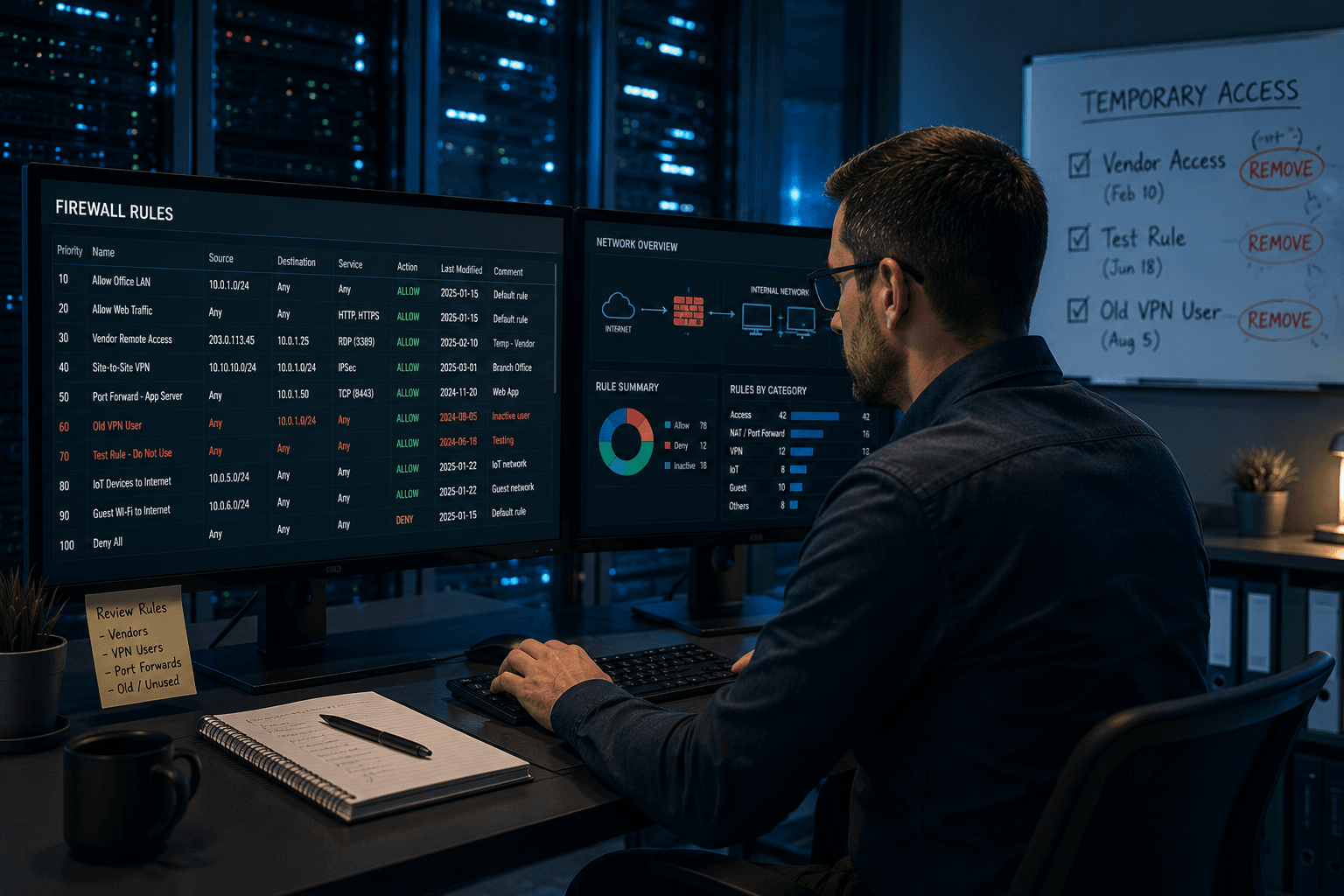
Sometimes a vendor, application, or internal system requires access that isn't permitted by the standard firewall policy.
In that situation, a firewall exception may be created. The exception itself isn't necessarily a security problem. It may be completely legitimate and necessary.
The problem begins when the exception isn't tracked.
A vendor, for example, might be granted access for troubleshooting. The work is completed, but the exception remains because nobody was assigned to review or remove it.
Months later, the business may still have an open port, vendor access, VPN permission, or another exception that no longer serves a purpose.
Firewall exceptions should therefore be documented and tracked. There should be a record of why the exception exists, who or what requires it, when it was created, and when it should be reviewed or removed.
Recent CISA cybersecurity guidance reinforces the importance of periodically auditing network-device configurations and comparing firewall changes with authorized activity.
The goal isn't to eliminate exceptions.
It's to make sure every exception still has a reason to exist.
When Was Your Firewall Last Reviewed?
Instead of asking:
"Do we have a firewall?"
Businesses should be asking:
"When was the last time someone reviewed our firewall rules?"
A firewall shouldn't simply be installed and forgotten.
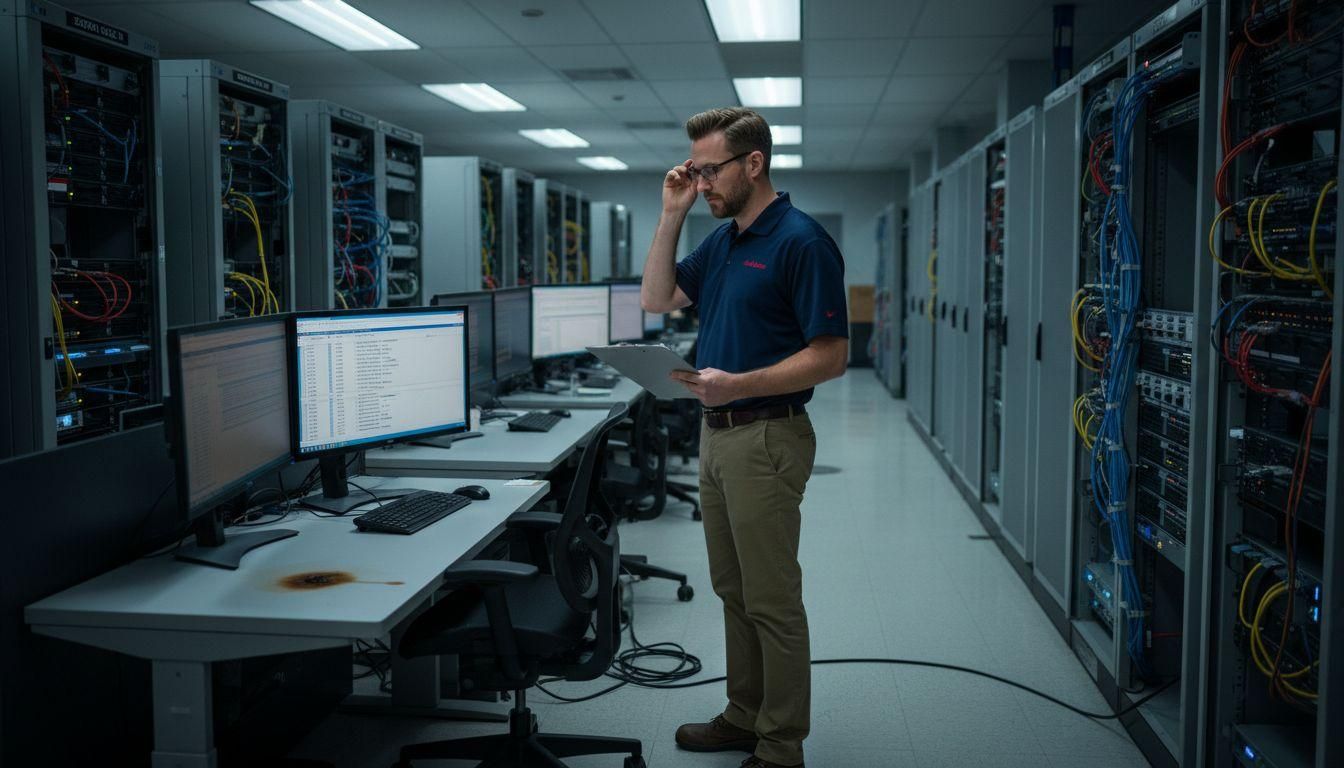
Periodic reviews can identify rules that no longer serve a purpose and verify that existing access still matches current business requirements.
Consider:
- Does that port forward still need to exist?
- Does a former vendor still have access?
- Are temporary rules still enabled?
- Can IoT devices communicate with systems they don't need?
- Can guest devices reach internal resources?
- Are VPN users able to access more than necessary?
The objective isn't to block everything. It's to make sure that access exists because it's required, not simply because nobody removed it.
A Firewall Should Protect the Inside of the Network Too
A firewall is often pictured as a wall between a business and the internet.
Modern network security goes beyond that.
NIST's Zero Trust guidance reinforces an important principle: a user or device shouldn't automatically be trusted simply because it's already inside the network.
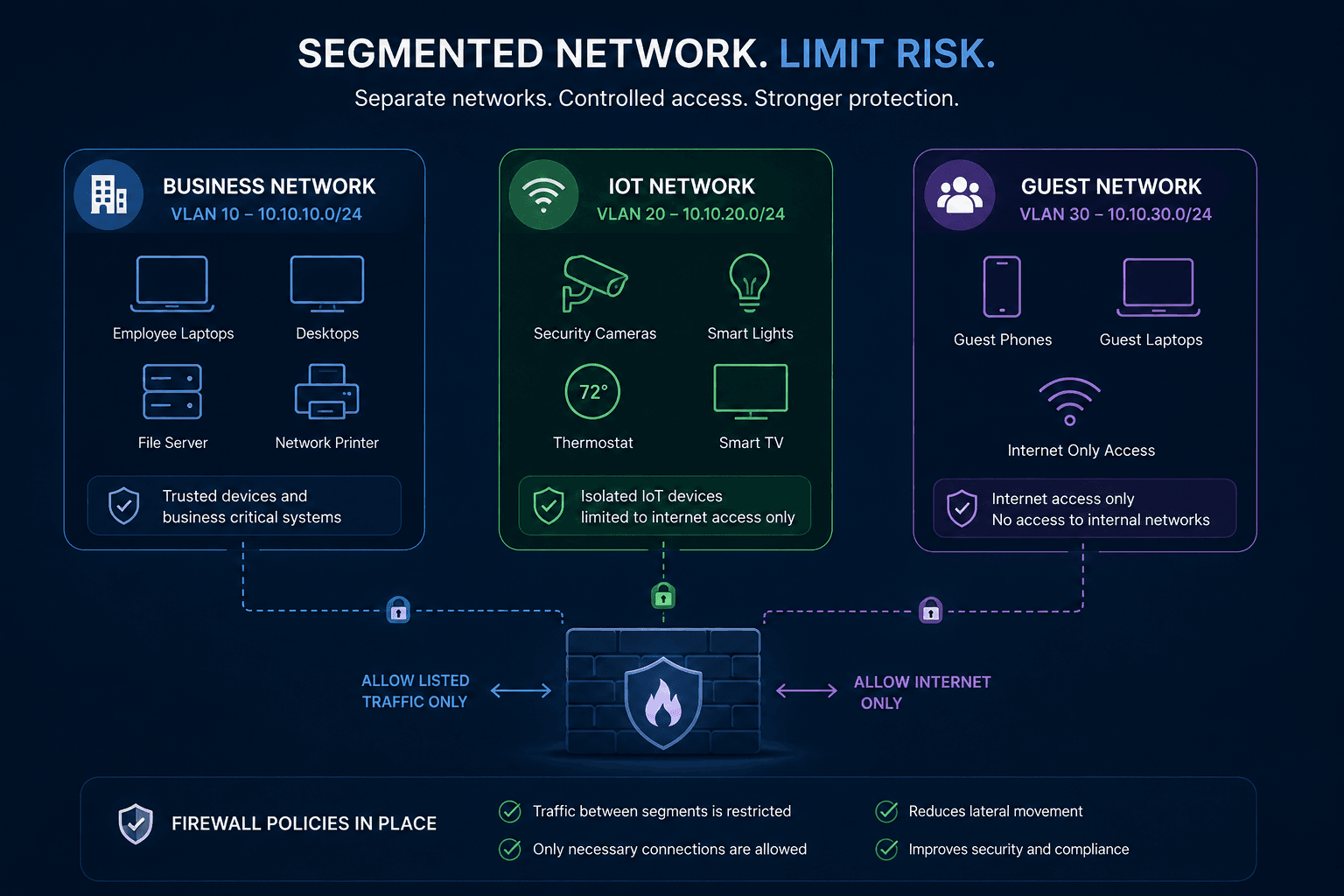
Businesses may have computers, servers, printers, cameras, smart TVs, phones, guest devices, and other connected equipment. They don't all need unrestricted access to one another.
Network segmentation and firewall policies can separate these devices and control communication between them. CISA's guidance on microsegmentation similarly highlights segmentation as a way to reduce attack surface and limit lateral movement if something becomes compromised.
A guest device may need internet access but no access to business computers. A smart TV may need the internet but have no reason to communicate with an accounting workstation.
The firewall therefore isn't only guarding the front door.
It can also control the doors inside the building.
A Firewall Is a Layer of Security — Not the Entire Solution
Even a well-configured and properly maintained firewall isn't the answer to every cybersecurity problem.
A stolen password, successful phishing email, malicious attachment, unpatched computer, or employee accidentally granting access can create security problems that a firewall alone may not prevent.
That's why effective cybersecurity relies on multiple layers of protection.
Endpoint security helps protect individual devices. DNS and web filtering can help prevent connections to malicious destinations. Multi-factor authentication adds another barrier when credentials are compromised. Software updates address known vulnerabilities. Backups provide a recovery path when prevention fails. Network segmentation and firewall policies help control how far a compromised device can reach.
Each layer has a different job.
If one layer fails or is bypassed, the others can still help reduce the risk or impact.
A firewall isn't the entire security strategy. It's one important layer within it.
An Updated Firewall Can Still Have Bad Rules
Keeping firewall software and firmware updated remains important. Updates can address vulnerabilities, improve reliability, and introduce new security capabilities.
But updates don't automatically clean up the configuration.
An unnecessary rule doesn't become necessary because the firewall received the latest firmware.
The device can be completely healthy while the policies running on it no longer reflect how the business operates.
Firewall maintenance should therefore include more than updates. It should also include reviewing rules, remote access, VPN permissions, exposed services, network segmentation, logs, and configuration changes.
The Better Question
Most businesses have some form of firewall protecting their internet connection.
So instead of stopping at:
"Do we have a firewall?"
Ask:
What is it allowing?
Why is that access required?
Are exceptions being tracked?
When was it last reviewed?
And what happens if the firewall isn't enough?
A firewall simply follows the policies it has been given. It doesn't know that a contractor finished their work six months ago or that an old server was decommissioned.
And it cannot replace the other layers required to protect a modern business.
Having a firewall matters. Managing it—and building security around it—matters even more.
References
Cybersecurity and Infrastructure Security Agency (CISA). Countering Chinese State-Sponsored Actors Compromise of Networks Worldwide to Feed Global Espionage System, 2025.
Cybersecurity and Infrastructure Security Agency (CISA). Microsegmentation in Zero Trust, Part One: Introduction and Planning, 2025.
National Institute of Standards and Technology (NIST). Implementing a Zero Trust Architecture — NIST SP 1800-35, finalized June 2025.