
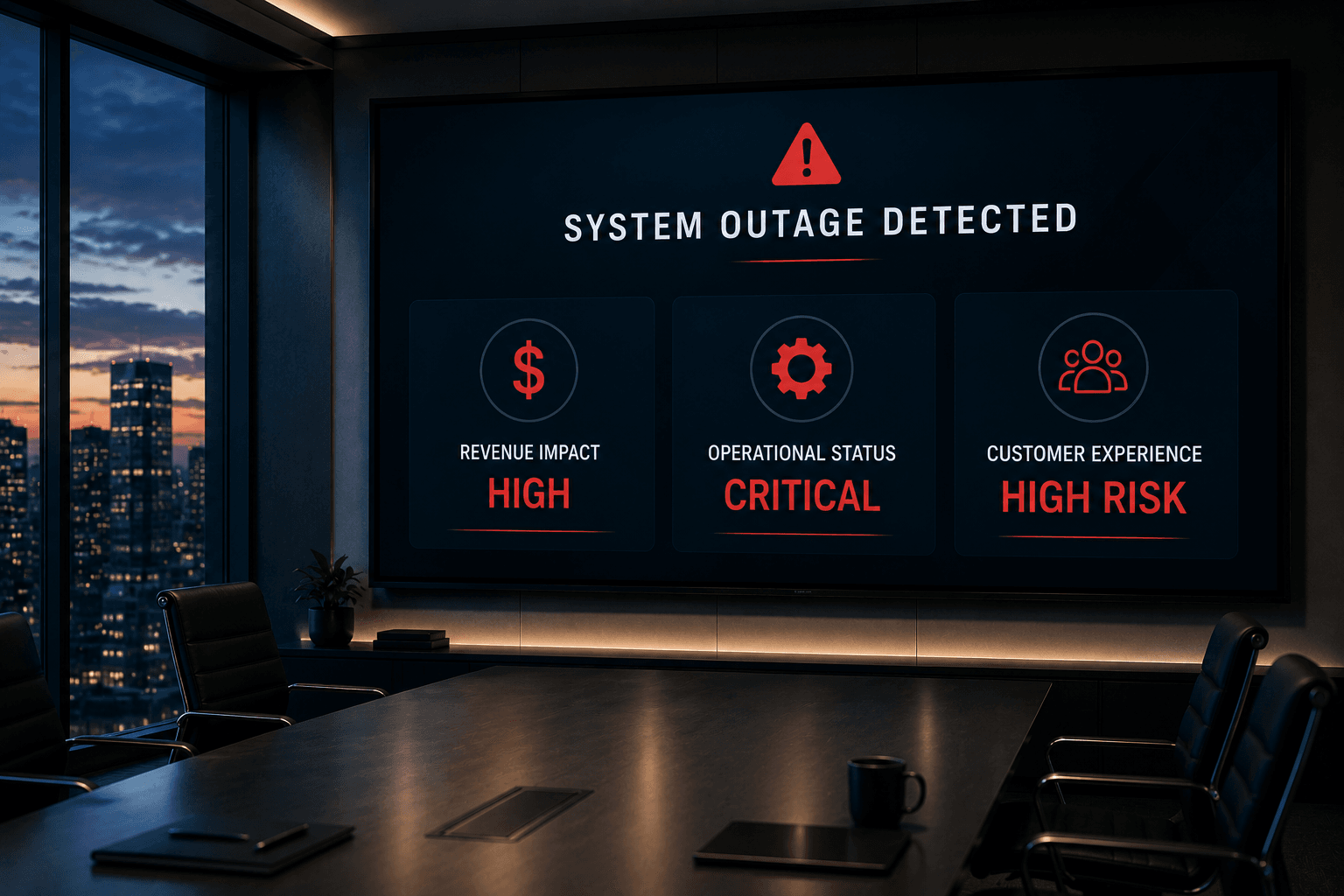
When Systems Stop, Revenue Stops


A decade ago, an unexpected technology outage was typically viewed as an operational inconvenience. Systems went down, the IT team resolved the issue, and business moved on.
Today, that same outage can immediately impact revenue, customer relationships, employee productivity, and organizational reputation.
As businesses become increasingly dependent on digital systems, downtime is no longer measured solely by how long services are unavailable. It is measured by lost opportunities, interrupted operations, delayed transactions, and diminished customer confidence.
For business leaders, the conversation has changed.
Downtime is no longer an IT problem.
It is a business risk with direct financial consequences.
The Cost of Standing Still
Every organization has critical systems that support daily operations. Email, cloud applications, communications platforms, customer databases, accounting systems, ERP platforms, and internet connectivity all play a role in keeping the business moving.
When one of those systems becomes unavailable, the effects spread quickly.
Sales teams lose access to customer information. Employees are unable to perform essential tasks. Customer service slows down. Orders are delayed. Leadership attention shifts from strategic initiatives to incident management.
While the technical issue may last only a few hours, the business impact can continue long after systems are restored.
The true cost of downtime extends far beyond lost access to technology.
It affects momentum.
Revenue Doesn't Wait
Many organizations still underestimate how closely technology availability is tied to revenue generation.
For some businesses, the connection is obvious. If an e-commerce platform becomes unavailable, transactions stop immediately.
For others, the impact is less visible but equally significant.
A professional services firm that loses access to client systems cannot deliver work efficiently. A manufacturer affected by a network outage may experience production delays. A company that loses access to communication platforms may struggle to support customers and close new business.
In each case, revenue generation slows or stops.
The longer the interruption, the greater the financial impact.
Executives routinely track sales performance, operational efficiency, and profitability. Technology availability deserves the same level of attention because it directly influences all three.
Customers Notice More Than Ever
Customers expect services to be available when they need them.
They rarely distinguish between a software failure, internet outage, cyberattack, or infrastructure issue. From their perspective, the result is the same: your organization is unavailable.
A single disruption may be forgiven.
Repeated disruptions create doubt.
Customers begin to question reliability, responsiveness, and overall service quality. In competitive markets, that uncertainty can influence purchasing decisions and customer loyalty.
Trust takes time to build and only moments to damage.
Cybersecurity Is Also a Business Continuity Challenge
Most cybersecurity discussions focus on prevention. Firewalls, endpoint protection, employee awareness training, and threat detection all play critical roles.
But prevention is only one part of the equation.
The more important question is what happens when an incident occurs.
Today's cybercriminals understand that operational disruption creates pressure. Whether through ransomware, account compromise, or service interruption, their objective is often to stop business operations and force difficult decisions.
The financial impact of a cyber incident frequently stems less from the attack itself and more from the downtime that follows.
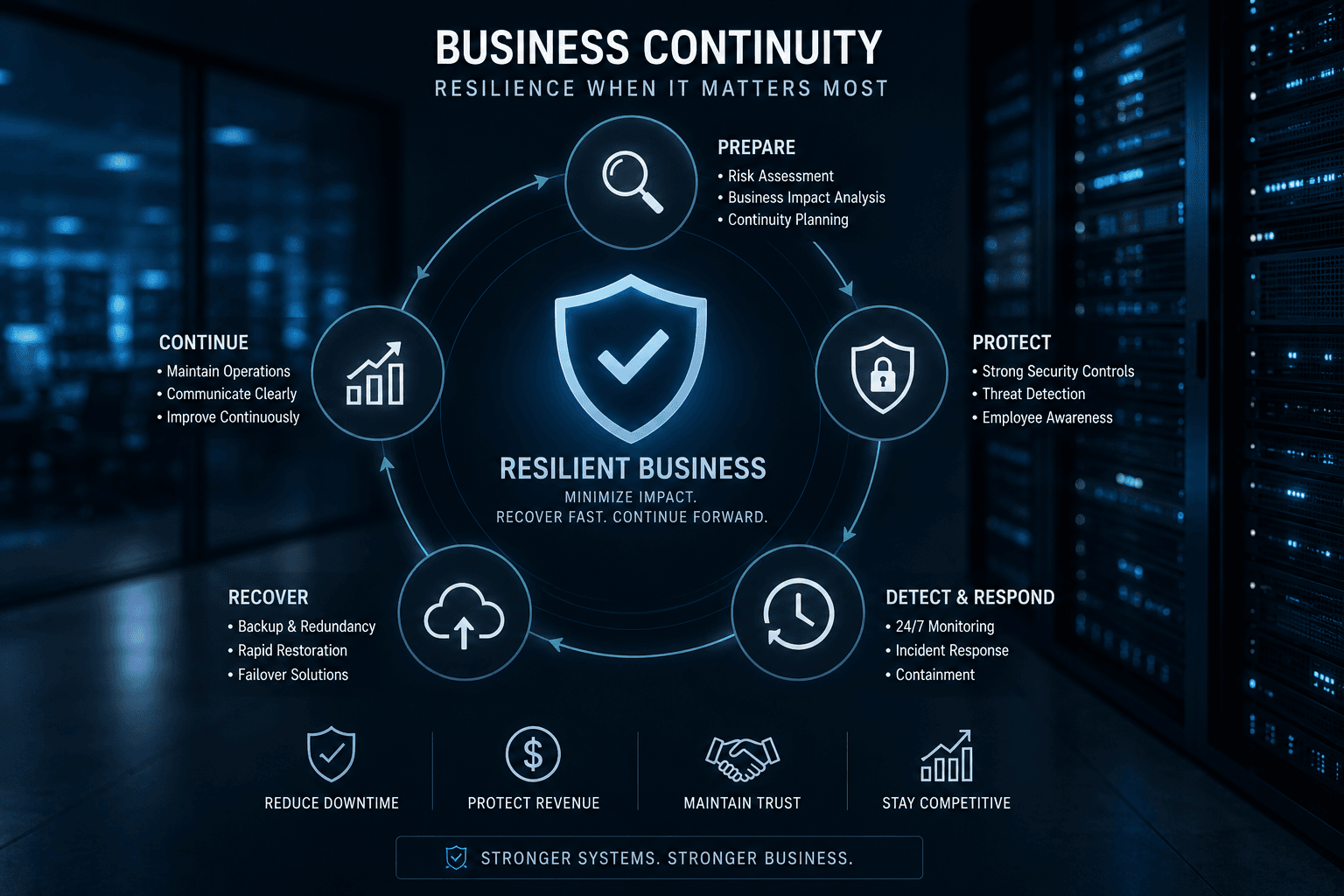
Organizations that can quickly contain issues, restore services, and maintain operations limit both financial losses and reputational damage.
Resilience is no longer just a technical objective.
It is a business imperative.
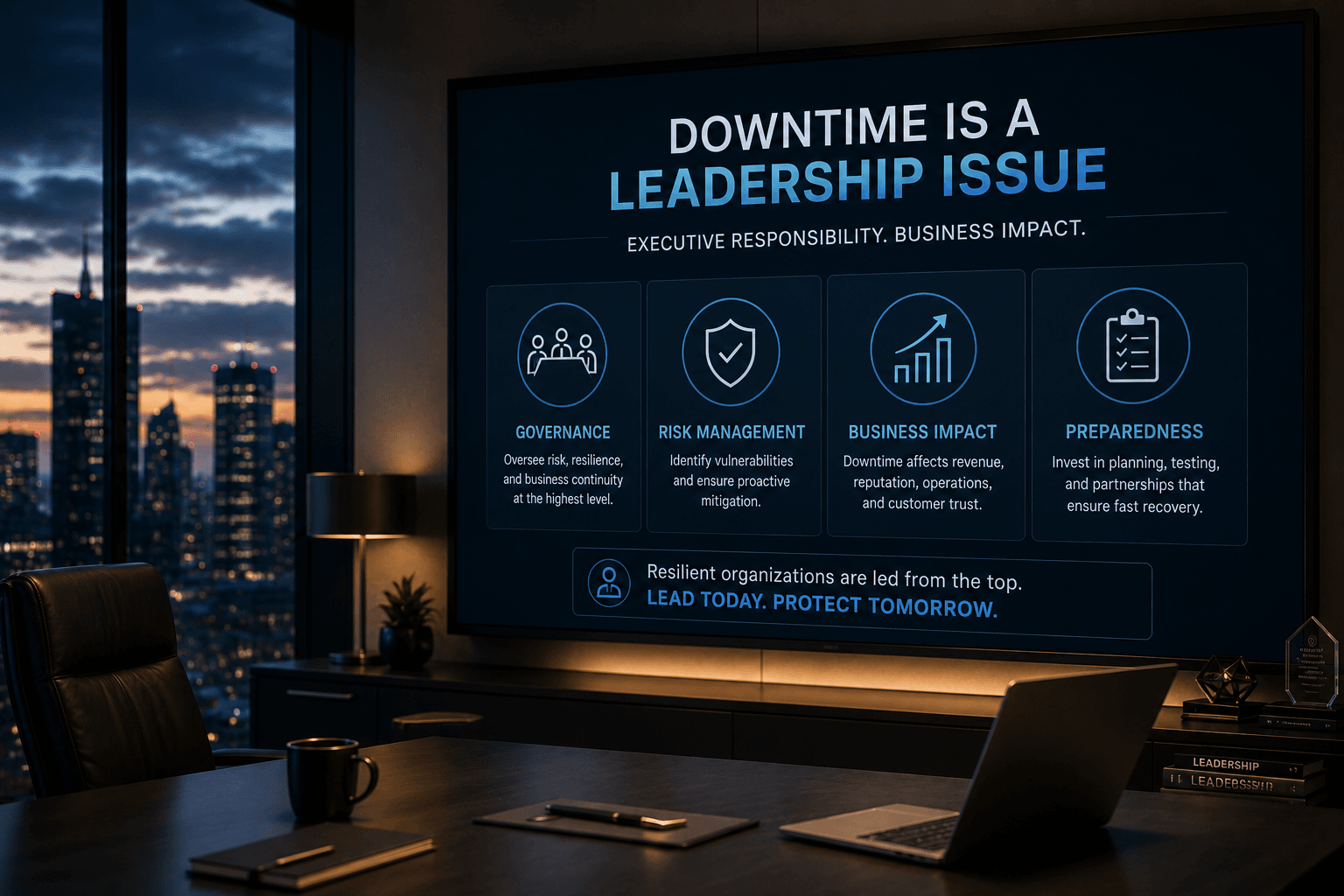
Downtime Is a Leadership Issue
Business continuity can no longer be viewed as the sole responsibility of the IT department.
Executive teams should have clear answers to several critical questions:
* Which systems are essential to revenue generation?
* What would a four-hour outage cost the business?
* Where are the single points of failure?
* How quickly can critical services be restored?
* Have recovery procedures been tested?
* Can employees continue operating during a significant disruption?
* How would customers be affected by an extended outage?
These are not technical questions.
They are business questions.
And the answers reveal how prepared an organization is to navigate operational disruptions without significant financial consequences.
Resilience Creates Competitive Advantage
Organizations often view investments in reliability, continuity, and risk reduction as necessary operational expenses.
Leading organizations view them differently.
Reliable systems support productivity, strengthen customer confidence, reduce operational risk, and allow leadership teams to remain focused on growth rather than recovery.
Most importantly, they protect revenue.
While competitors struggle through outages and disruptions, resilient organizations continue serving customers, supporting employees, and executing their business objectives.
That consistency becomes a competitive advantage.
The Bottom Line
Technology now sits at the center of nearly every business process.
As a result, system availability is no longer simply an IT metric. It is a measure of business performance.
Revenue, productivity, customer satisfaction, and operational efficiency all depend on reliable access to the systems that keep the organization running.
The organizations that succeed over the long term are not necessarily those that avoid every disruption. They are the ones that minimize the impact of disruption, recover quickly, and maintain continuity when challenges arise.
Because in today's business environment, the equation is straightforward:
When systems stop, revenue stops.
Ask yourself:
If a critical system became unavailable tomorrow, how quickly could your organization recover—and what would it cost while you were down?
The answer may reveal more business risk than you realize.