
What Happens When Business Security Tools Don’t Work Together


A business can have several security tools in place and still struggle to answer a surprisingly simple question:
If something unusual happens, will anyone see the whole picture?
One system may protect employee computers. Another may control email. A firewall watches network traffic. Cloud applications have their own security settings. Backups operate separately. User accounts may be managed somewhere else again.
Individually, each tool can be doing exactly what it is supposed to do.
The difficulty begins when nobody has a clear view of how those pieces work together.
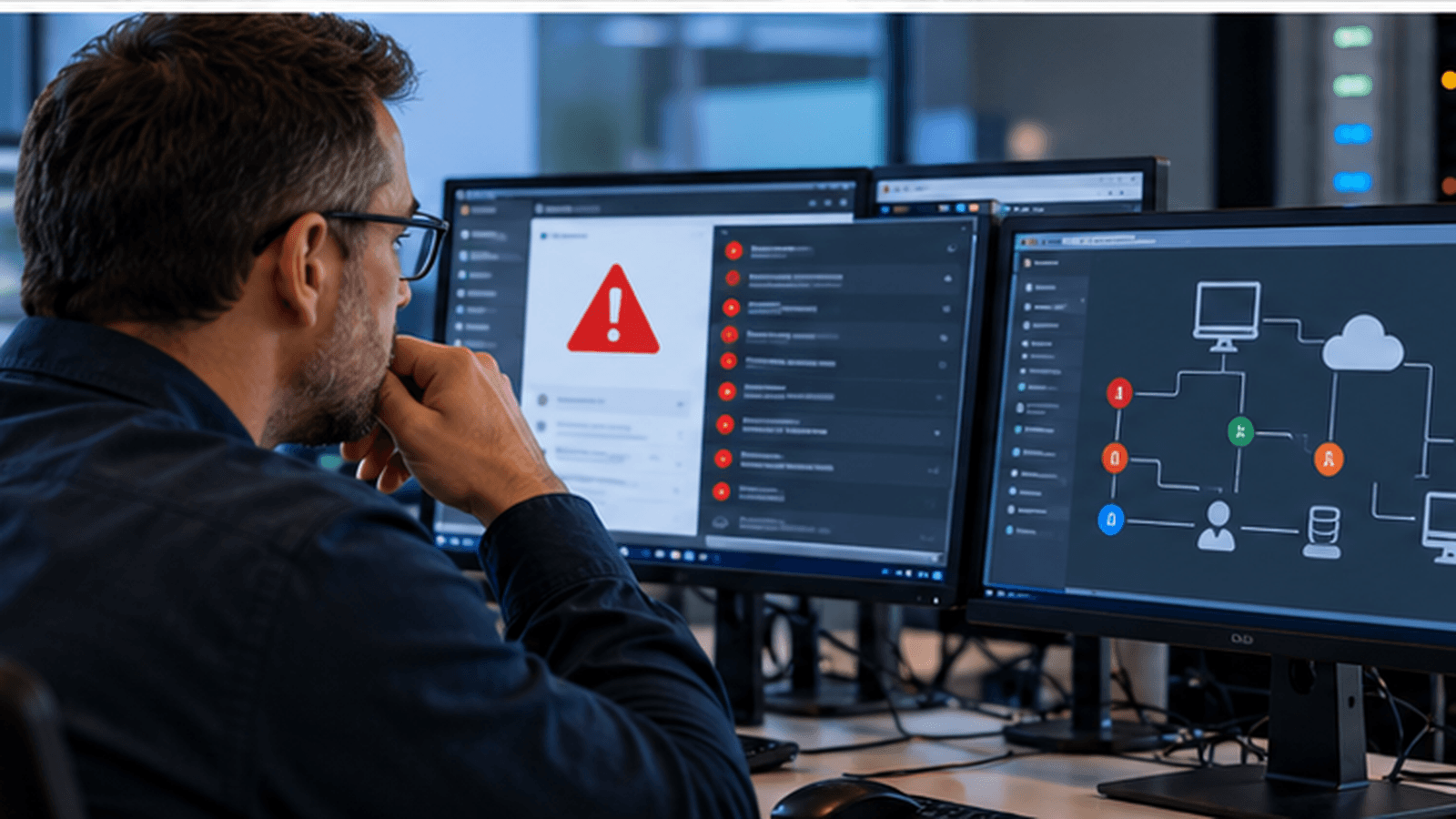
An alert appears in one place. A related event exists somewhere else. A change to an employee account affects another system, but the connection between them is not obvious. People responsible for technology are left piecing together information from several consoles, notifications and reports before they can understand what is actually happening.
For a small or medium-size business, the problem is usually not that it deliberately built a fragmented security environment.
It is that the environment grew that way.
Security Usually Grows One Decision at a Time
Most businesses do not sit down one morning and design their entire security environment from scratch.
They solve problems as they appear.
A new email protection service is added after unwanted messages become troublesome. A different solution is introduced to protect computers. Remote work creates a need for another layer of access control. A new business application comes with its own administrative and security features.
Each decision may be perfectly reasonable.
Over time, however, the business can end up with a collection of protections that were selected at different times, for different reasons and sometimes by different people.
The issue is not necessarily the number of tools.
The issue is whether the business still understands the environment as a whole.
The NIST Cybersecurity Framework takes a similarly broad view of cybersecurity. Rather than treating protection as one product or activity, it organizes cybersecurity around the functions of Govern, Identify, Protect, Detect, Respond and Recover. Those functions are intended to work together as part of an ongoing approach to managing risk. NIST Publications
That distinction matters.
A business can invest heavily in Protect while still having difficulty with Identify, Detect or Respond.
The First Gap Is Often Visibility
Imagine an employee account begins behaving differently from normal.
One system records a sign-in. Another sees activity from a computer. A cloud service records changes to files. An email platform produces its own event.
Each individual event may look ordinary enough.
What matters may be the relationship between them.
When security information is spread across disconnected systems, recognizing that relationship can take longer and require more manual investigation.
This is where visibility becomes an operational issue, not merely a technical one.
The person trying to understand the situation may need to determine:
- Which systems are involved?
- Which user and device are connected to the activity?
- Was the activity expected?
- Did another security system already detect something related?
- Who is responsible for reviewing each source of information?
- What action has already been taken?
If nobody can answer those questions efficiently, the business may technically have considerable protection while still struggling to understand what is happening.
NIST specifically treats identification of systems, assets and services as part of effective cybersecurity risk management. CISA likewise recommends maintaining an updated inventory so organizations can better identify known, unknown and unmanaged assets. NIST
That principle can extend beyond knowing what equipment exists.
A business also needs to understand which security controls are supposed to protect it.
More Tools Do Not Automatically Mean Better Coverage
It is easy to assume that adding another security product closes another gap.
Sometimes it does.
But additions can also create overlap.
Two systems may perform similar functions while another important area receives little attention. Multiple products may generate alerts about the same event, creating more noise without providing more clarity.
There can also be gaps between responsibilities.
One provider manages the network. Another supports a business application. Someone internally administers employee accounts. A separate service protects endpoints.
Then something crosses those boundaries.
Who investigates it?
This is one reason the question What security products do we have? is less useful than:
What are we trying to protect, what could interrupt it, and which controls are responsible for each part?
The answer should start with the business, not the product list.
For example, protecting customer records may involve employee identities, computers, cloud applications, network access, backups and administrative permissions.
No single tool necessarily owns the entire problem.
Disconnected Tools Can Complicate Everyday Changes Too
Security coordination matters even when there is no incident.
Consider an employee leaving the company.
Disabling the person's main account may be only one step.
They might also have access to:
- cloud applications
- shared information
- remote access
- administrative systems
- business devices
- credentials or accounts maintained separately from the central identity system
If those systems do not share a common access process, someone needs to know they exist and remember to update each one.
The same issue appears when employees change roles, contractors finish projects or new applications are introduced.
In that sense, fragmented security can create ordinary administrative problems long before it creates an obvious security problem.
A business that cannot clearly see who has access to what may have difficulty confirming that changes were completed correctly.
Alerts Are Only Useful When Someone Knows What to Do With Them
Security tools generate information.
That does not necessarily mean the information becomes useful action.
A small business can have a system capable of detecting suspicious behavior while still having unanswered questions around the alert itself:
Who receives it?
How quickly is it reviewed?
What information should be checked next?
Who has authority to disable an account or isolate a computer?
Who determines whether the business can keep operating normally?
These questions connect technology with responsibility.
The current NIST Cybersecurity Framework places particular emphasis on governance, including roles, responsibilities and communication around cybersecurity risk. NIST
For a smaller organization, governance does not have to mean creating a large formal security department.
Sometimes it begins with something much simpler: making sure everyone understands who owns the next decision.
Start With the Business Environment, Not a Replacement Shopping List
When a security environment feels fragmented, the answer is not automatically to replace everything.
A useful first step is to map what already exists.
That conversation can be surprisingly revealing.
List the important business systems and information first. Then identify which tools or processes protect them. Look at who manages each component, what information it produces and what happens when something needs attention.
The goal is to find the places where the environment depends on assumptions.
For example:
Are important systems missing from the security picture?
Are two tools doing essentially the same job?
Are alerts being generated but rarely reviewed?
Can user access be changed consistently across systems?
Does everyone know who is responsible when an issue crosses between providers or platforms?
Those questions can expose gaps without assuming that every gap requires another purchase.
Sometimes the improvement is technical integration.
Sometimes it is removing unnecessary complexity.
Sometimes it is simply documenting ownership and creating a better operational process.

Integration Should Make the Environment Easier to Understand
The word integration can sound as though every system needs to feed one enormous dashboard.
That is not always necessary.
A more practical goal is coordination.
Important information should reach the people who need it. Related events should be understandable together where feasible. Account and access changes should follow a consistent process. Responsibilities should be clear enough that an issue does not sit between two systems simply because each person assumed someone else was handling it.
A useful test is not whether everything is connected technically.
It is whether the business can answer:
What protects this part of our operation, who is watching it, and what happens when something goes wrong?
If the answer requires several people, several systems and several guesses, there may be work to do.
Security Should Behave Like a System
Businesses naturally accumulate technology over time.
Security tools are no different.
The challenge is making sure yesterday's individual decisions still form a sensible environment today.
Protection is stronger when the business can see what it has, understand how the pieces relate, recognize important activity and coordinate a response when something needs attention.
That does not require buying every available security product.
It requires treating security as a connected business process rather than a collection of separate boxes.
If your organization has added security systems over the years and it has become difficult to explain how they work together, Nivo 5 can help you review the environment, identify operational gaps and understand where better coordination may simplify protection.