
Vendor Risk Is Now Supply Chain Risk


For years, vendor management was largely treated as a procurement exercise. Organizations evaluated suppliers based on price, service quality, and contract terms, while IT focused on technical integrations and security assessments. That approach is no longer sufficient.
Today, every technology vendor has become part of your operational supply chain. Whether they provide cloud infrastructure, cybersecurity services, business applications, internet connectivity, payment processing, or managed IT services, their resilience directly affects your ability to operate.
A failure anywhere in that chain is no longer just a vendor problem. It quickly becomes your business problem.
Modern Businesses Depend on External Technology
Few organizations operate entirely on systems they own and control.
A typical mid-sized business may rely on dozens—sometimes hundreds—of external providers every day:
* Cloud platforms
* SaaS business applications
* Internet and telecommunications providers
* Payment gateways
* Managed Service Providers (MSPs)
* Cybersecurity vendors
* Backup and disaster recovery providers
* Identity and authentication services
* Data centers
* Software developers and API providers
Each one represents a dependency. Each dependency represents operational risk.
The more organizations embrace digital transformation, the more interconnected these relationships become.
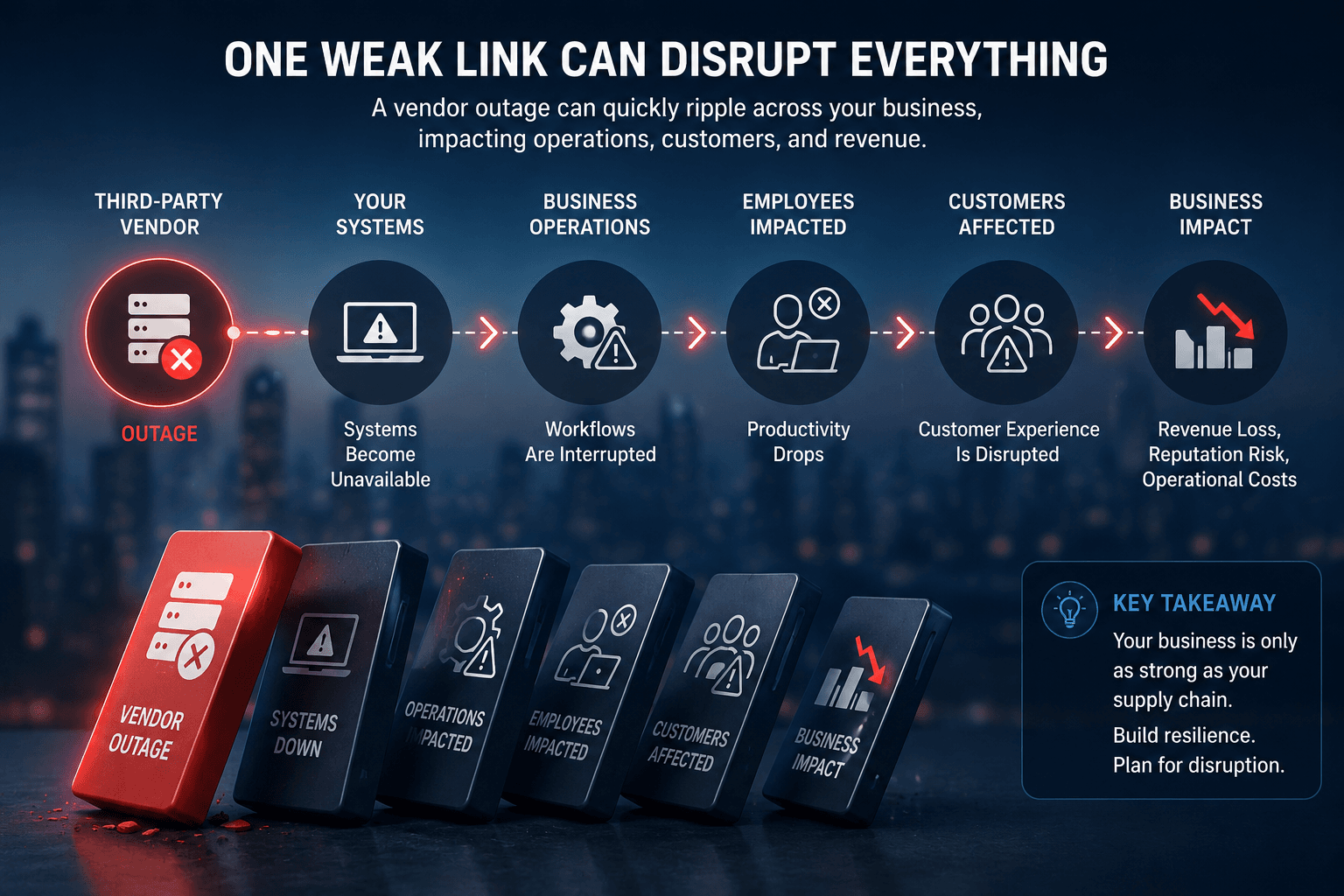
One Weak Link Can Disrupt Everything
Recent years have demonstrated that organizations do not need to be directly attacked or experience internal failures to suffer major disruptions.
Instead, outages frequently originate somewhere else in the supply chain.
A cloud provider experiences a regional outage.
An identity provider becomes unavailable.
A software vendor releases a defective update.
A cybersecurity provider suffers an incident.
A telecommunications carrier experiences a network failure.
Suddenly:
* Employees cannot log in.
* Customers cannot access services.
* Orders cannot be processed.
* Manufacturing slows or stops.
* Revenue-generating activities are interrupted.
Your infrastructure may be healthy, but your business is still offline.
Cybersecurity Has Changed the Conversation
Cybersecurity has accelerated the importance of vendor risk.
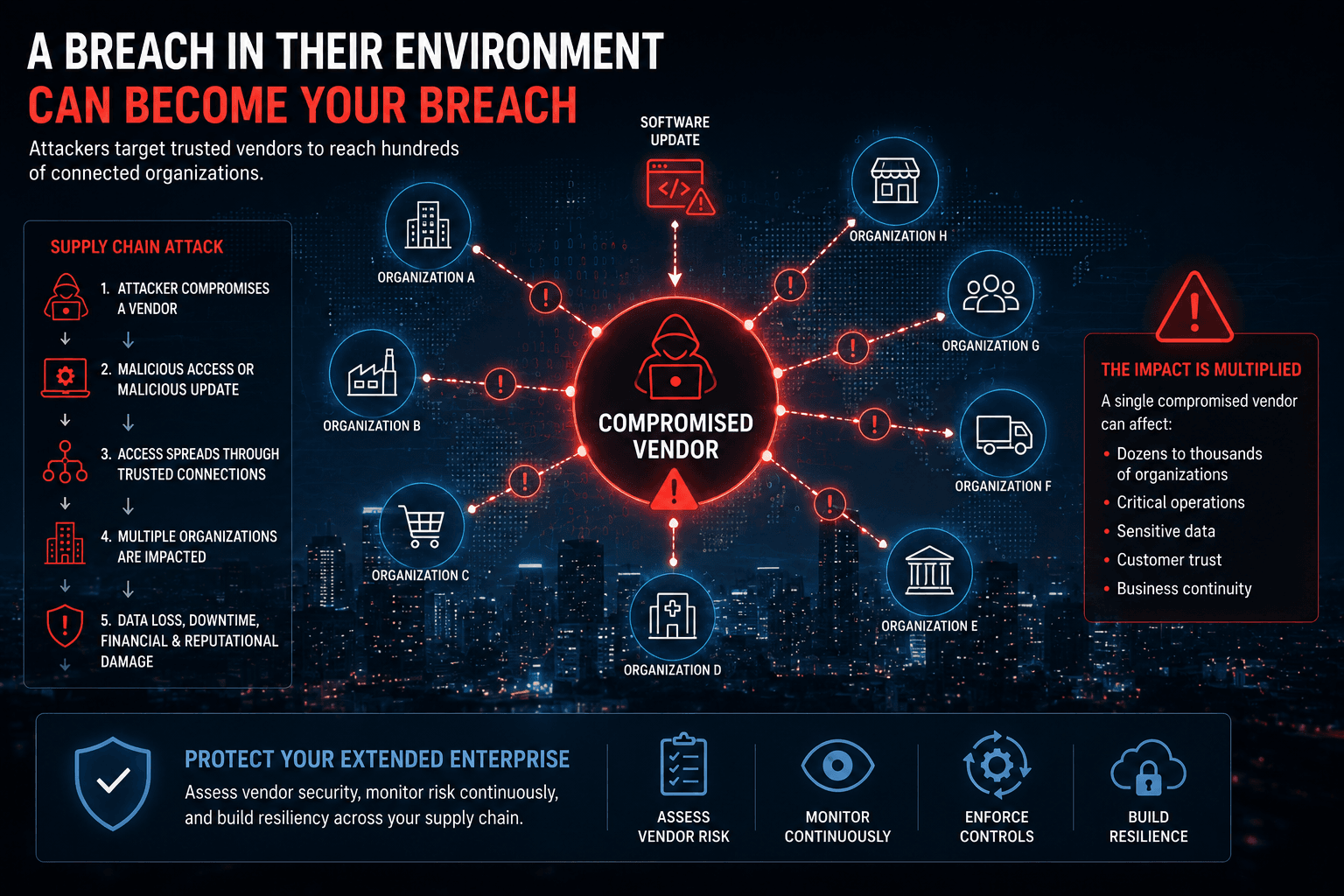
Attackers increasingly target trusted suppliers because compromising one vendor can provide access to hundreds—or thousands—of downstream customers.
This has transformed supply chain attacks into one of today's most significant cybersecurity concerns.
Organizations can invest heavily in protecting their own environments, but if a critical supplier has inadequate security controls, weak governance, or poor operational resilience, the exposure extends well beyond that single organization.
Security is no longer evaluated solely within organizational boundaries.
It must include the entire ecosystem.
Vendor Assessments Should Go Beyond Security Questionnaires
Many organizations conduct annual vendor reviews that focus primarily on compliance checklists.
While necessary, questionnaires alone rarely provide enough insight into operational resilience.
Decision-makers should also understand:
* How critical is this vendor to business operations?
* What would happen if the service became unavailable for several hours—or several days?
* Does the vendor maintain tested disaster recovery capabilities?
* Are there documented business continuity plans?
* How quickly can services realistically be restored?
* Is there geographic redundancy?
* Are there alternative providers if necessary?
* Does the vendor regularly communicate incidents and service disruptions?
The objective is not to eliminate risk.
It is to understand where risk exists and ensure the organization can continue operating when disruptions occur.
Build Resilience Instead of Assuming Availability
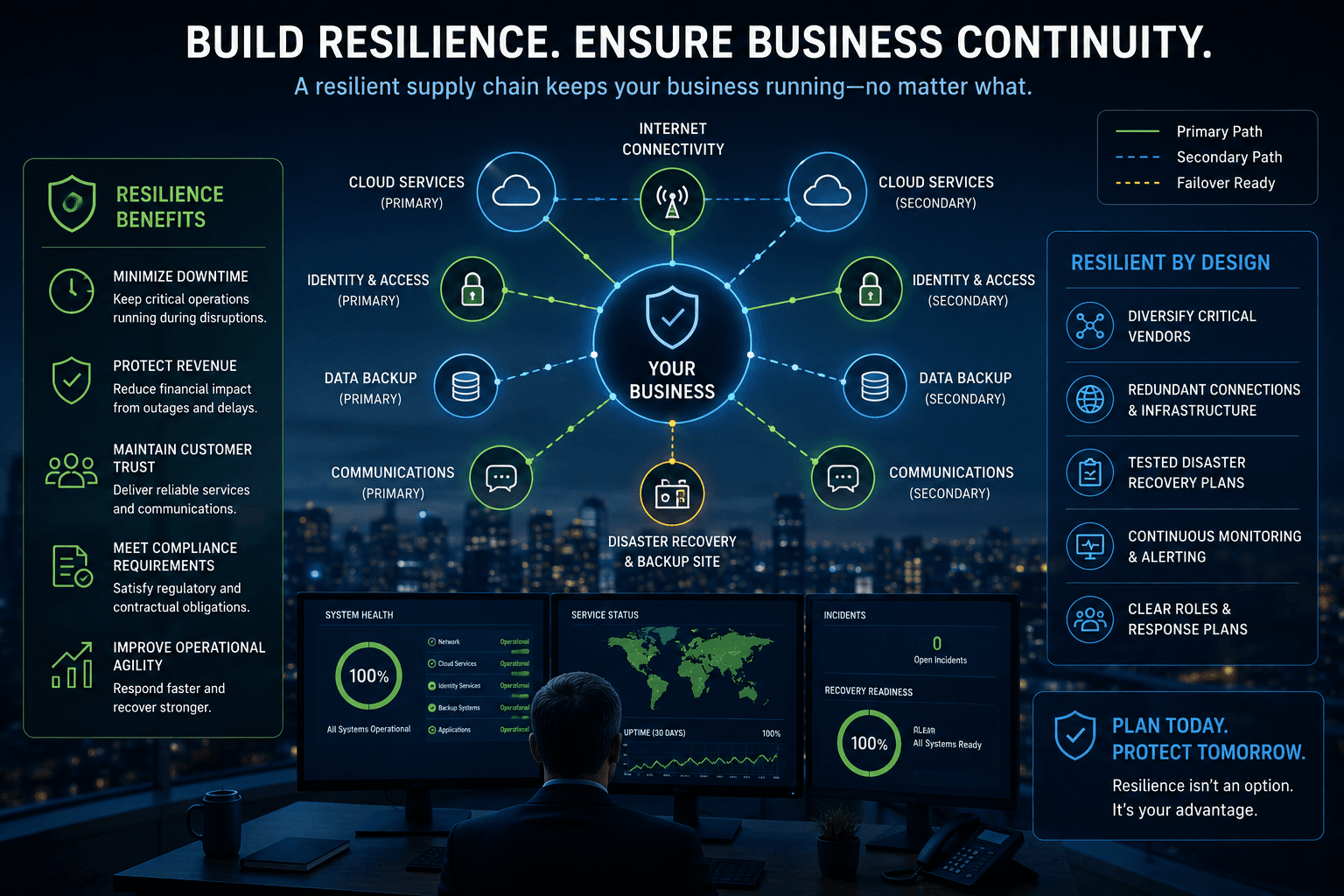
Many organizations unknowingly create single points of failure by depending entirely on one provider for critical services.
Resilience comes from reducing concentration risk.
This may include:
* Multiple internet providers
* Backup authentication methods
* Secondary backup platforms
* Alternate communication channels
* Redundant cloud architectures
* Clearly documented contingency procedures
These investments often appear unnecessary—until the day they prevent a costly outage.
Vendor Risk Is a Business Leadership Issue
Managing vendor risk is no longer solely the responsibility of IT, procurement, or cybersecurity teams.
Executive leadership should understand how external dependencies affect:
* Operational continuity
* Financial performance
* Customer experience
* Regulatory obligations
* Organizational reputation
Technology supply chains deserve the same level of oversight as physical supply chains.
Both are essential to keeping the business running.
Final Thoughts
Every organization depends on technology partners. The question is no longer whether those vendors are important, but how prepared your business is when one of them experiences an outage, cyber incident, or operational failure.
Organizations that identify critical dependencies, assess resilience, and plan for supplier disruptions are far better positioned to maintain operations when unexpected events occur.
In today's interconnected business environment, vendor risk is no longer just a procurement concern.
It has become a core component of operational resilience.