
Simplifying IT Isn't About Fewer Vendors—It's About Better Visibility


Most businesses do not intentionally build a complicated IT environment. It happens one decision at a time.
An internet provider handles connectivity. Someone else installs the network and Wi-Fi. Microsoft 365 comes through a reseller. Another company manages phones, video surveillance, door access system, bulding automation. Backup, cybersecurity, remote support, and other services are added as new needs appear.
Every decision may have made sense at the time.
The problem appears later, when the business needs to answer a simple question:
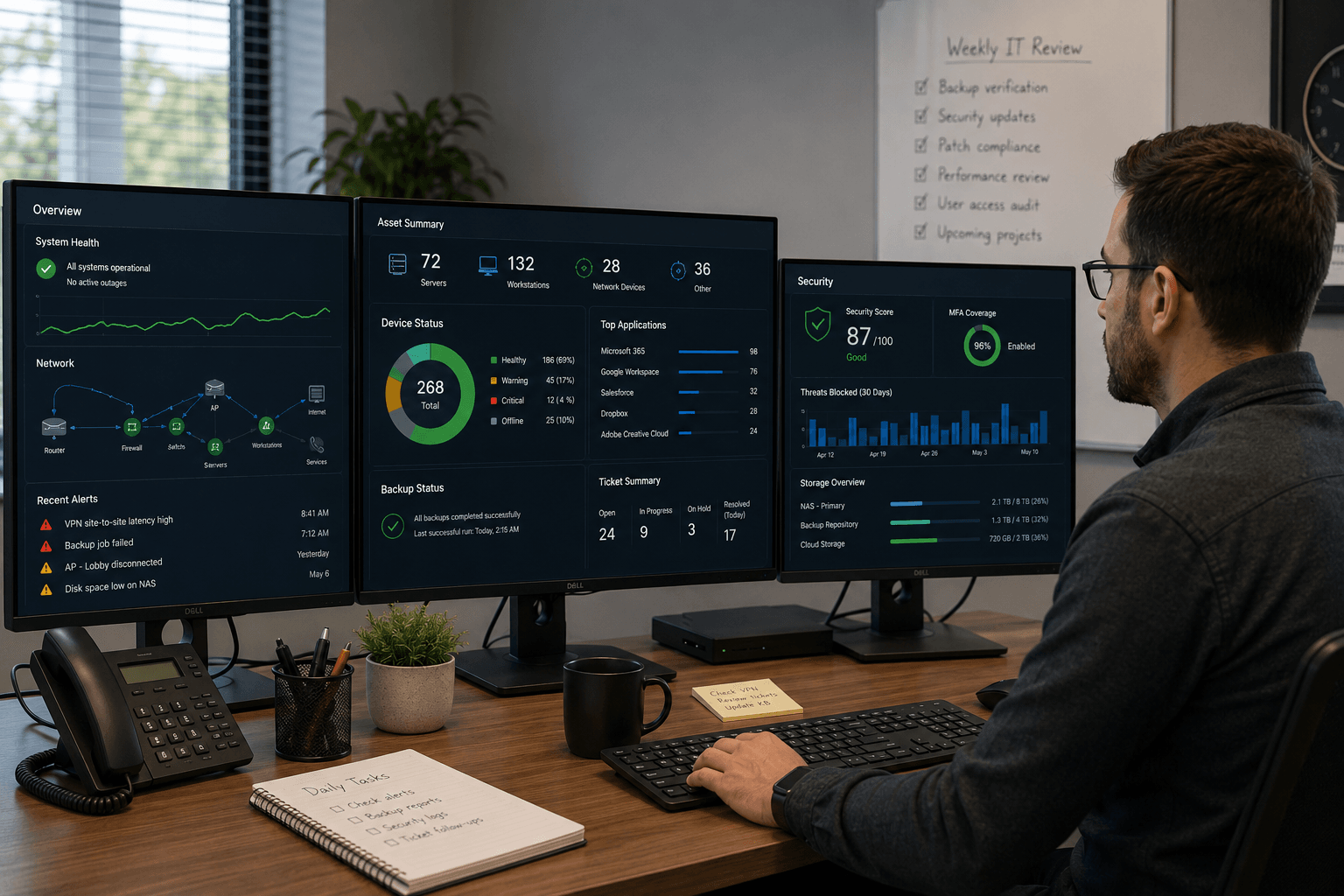
Who actually has visibility over the entire IT environment?
That is why IT consolidation should not simply be about reducing the number of vendors a company pays. Its real value is reducing the gaps between those vendors—and creating clearer ownership of the technology the business depends on.

The Problem Isn't the Number of Tools
Modern businesses already have a significant amount of technology to manage.
Okta's Businesses at Work 2025 report found that its customers used an average of 101 applications per organization, crossing 100 for the first time. Canadian organizations in the report averaged 70 applications.
Yet visibility isn't necessarily keeping pace. Flexera's 2025 State of ITAM Report found that only 43% of surveyed organizations reported complete visibility across their IT assets.
The takeaway isn't that businesses are using too much technology. It's that as the environment grows, understanding who manages what becomes increasingly important.
For a small or mid-sized business, that challenge can surface through surprisingly basic questions.
Who owns the Microsoft 365 administrator account? Which company manages the firewall? When was the backup last tested? Is the old remote-access software still required? Who controls the domain? Are two different security products doing essentially the same job?
If nobody can answer those questions confidently, adding another product or provider may only increase the problem.
Where Fragmented IT Becomes Expensive
The cost of fragmentation is not always visible on an invoice.
Imagine an employee suddenly cannot access an important cloud application.
The application provider says its service is operational. The ISP confirms the internet connection is online. The network provider sees no obvious firewall issue. The employee still cannot work.
Now the business has a new responsibility: coordinating its own IT providers.

Someone has to determine whether the problem involves the internet connection, DNS filtering, firewall rules, authentication, the employee's computer, or the application itself.
The technical problem might take ten minutes to correct once identified. Determining who is responsible for those ten minutes can take considerably longer.
This is where effective consolidation changes more than convenience.
A business may still have an ISP, software vendors, cloud providers, telecommunications companies, and other specialists. But instead of the customer being responsible for navigating those relationships, one IT provider can maintain the broader technical picture and coordinate with the appropriate third party.
The goal isn't necessarily one vendor. It's one point of accountability.
What Happens When Providers Come and Go?
There is another side to IT fragmentation that is easy to overlook: every provider can leave something behind.
One company may have created administrator accounts. Another may have installed remote-access software. A previous consultant may still have credentials. Software subscriptions may renew automatically even though nobody actively uses them. Documentation may exist, but only in an old email thread or in the records of a provider the business no longer works with.
Over several years, those small decisions accumulate.
This is why visibility is not just about knowing which products a company uses. It also means understanding the relationships surrounding those products:
Who has administrative access? Which services are still required? Who receives alerts? Who controls renewals? Where are configuration details documented? And what needs to be removed when a provider relationship ends?
Consolidating IT management creates an opportunity to answer those questions consistently.
It also makes transitions easier. When a new employee, location, application, or provider is introduced, there is already a clearer understanding of how that change fits into the existing environment.
Consolidation Should Never Mean Giving Up Control
There is an important distinction between simplifying IT management and becoming completely dependent on one provider.
A business should still maintain ownership and visibility of critical assets such as its domain, cloud tenant, licenses, business data, backups, and administrative accounts.
Good consolidation should actually make that information more transparent, not less.
The business should know what it owns, what its IT provider manages on its behalf, which outside vendors are involved, and how those relationships could be transferred if circumstances change.
This is especially important when selecting a provider. Centralized management should make the business easier to operate—not make it impossible to leave.
Fewer Blind Spots Matter More Than Fewer Vendors
A business does not need to eliminate every specialized provider to simplify IT.
It needs an environment where someone understands how the pieces fit together.
When there is a network problem, someone owns it through resolution. When a new service is introduced, someone considers how it interacts with existing systems. When an employee leaves, someone knows which accounts and services need to be reviewed. When management asks what technology the company is paying for, there is an answer.
That is a much better measure of IT consolidation than simply counting vendors.
Because the objective is not to have fewer company names on invoices.
It is to have fewer gaps where nobody is looking.
Sources
- Okta, Businesses at Work 2025 — Application adoption and average applications per organization. View source
- Flexera, 2025 State of ITAM Report — IT asset visibility findings. View source