
If One Click Can Cripple Your Business, The Problem Isn't The Employee


Cybersecurity Is Not an Employee's Job
Over the last decade, organizations have increasingly embraced a new cybersecurity philosophy.
Employees are now being called the "human firewall," "security gatekeepers," or the "first line of defense." Organizations invest heavily in awareness programs, phishing simulations, security quizzes, compliance training, and recurring reminders designed to make users more security-conscious.
While awareness has its place, a fundamental question is rarely asked:
When did cybersecurity become the responsibility of accounting, sales, administration, operations, customer service, and every other non-technical department?
The reality is that cybersecurity is a technical discipline.
Just as organizations do not expect employees to manage network routing, configure firewalls, secure cloud infrastructure, review third-party integrations, govern identity permissions, monitor attack surfaces, or investigate security events, they should not expect employees to carry the primary burden of cybersecurity risk.
Yet that is exactly what has happened.
Over time, many organizations have shifted cybersecurity accountability away from technology teams and onto end users. Employees are repeatedly told that they are the organization's first line of defense, while the underlying technology environment often receives far less attention.
The result is predictable.
Employees are expected to protect organizations while operating in environments where:
- SaaS applications are poorly governed
- Cloud services lack visibility
- Third-party integrations are rarely reviewed
- Identity permissions accumulate unchecked
- Shadow IT continues to grow
- Public-facing assets remain exposed
- Security controls are inconsistently implemented
- Asset inventories are incomplete
- Vendor access is poorly managed
- Monitoring and detection capabilities are limited
- Legacy infrastructure remains in production long after it should have been retired
When an employee clicks a malicious link, opens an attachment, approves a fraudulent MFA request, or falls victim to a sophisticated social engineering attack, the discussion often centers on user failure.
Rarely does the conversation focus on the technical safeguards that should have prevented the incident from becoming a breach in the first place.
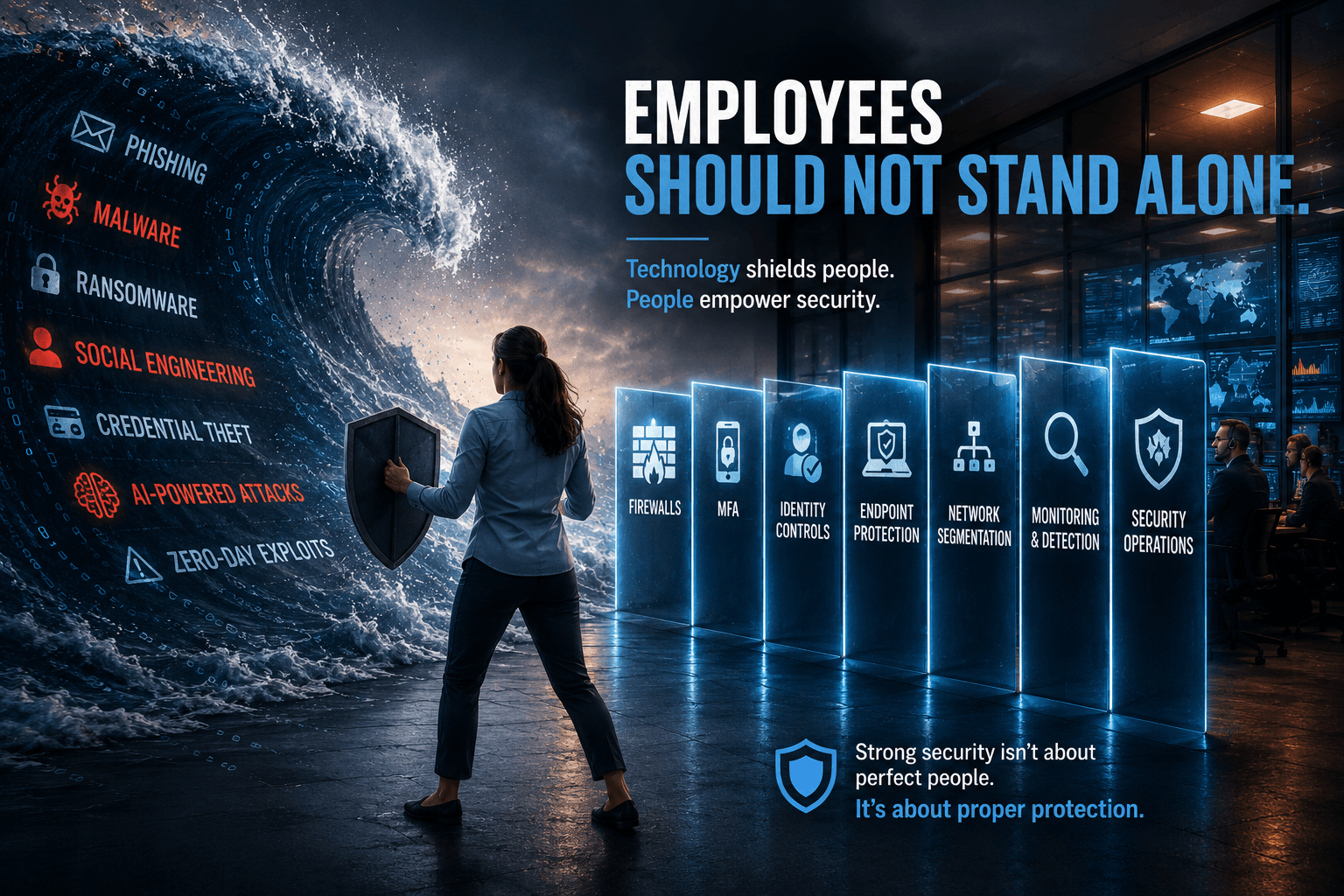
The Human Firewall Myth
The term "human firewall" sounds appealing.
Unfortunately, it creates a dangerous assumption: that people can consistently serve as reliable security controls.
Humans are not designed to operate as security technologies.
They become distracted. They work under pressure. They multitask. They trust colleagues. They respond to urgency. They make mistakes.
Cybercriminals understand this better than most organizations.
Modern attackers do not attempt to defeat technology first.
They target human behavior because it is predictable.
That does not mean employees are the problem.
It means organizations should stop treating them as the primary solution.
Cybercriminals Understand Human Behavior Better Than Most Security Programs
The cybersecurity awareness industry was largely built around teaching users how to identify suspicious emails.
Today's threat landscape has evolved far beyond that model.
Attackers now leverage:
- Artificial intelligence
- Deepfake voice technology
- Business email compromise
- Social engineering
- Trusted vendor impersonation
- Executive impersonation
- MFA fatigue attacks
- Personalized phishing campaigns
- Publicly available business intelligence
- Many attacks contain no obvious warning signs.
Some are virtually indistinguishable from legitimate business communications.
Expecting employees to perfectly identify every malicious interaction is not a realistic security strategy.
Eventually, someone will click.
The question is whether the organization has designed its environment to withstand that reality.
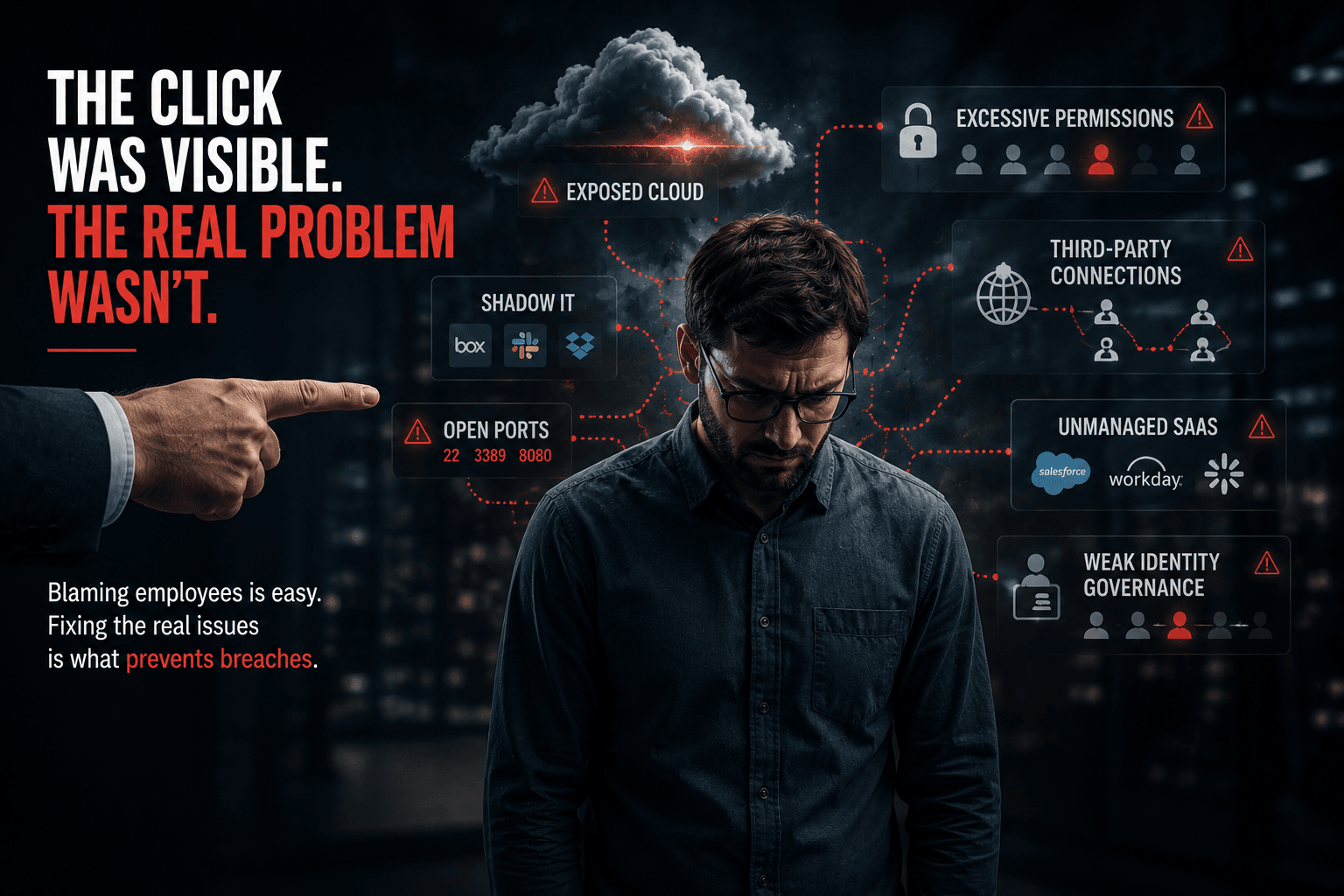
The Cybersecurity Accountability Gap
A concerning trend has emerged across many organizations.
When an incident occurs, accountability is increasingly directed toward the employee involved rather than toward the systems, processes, and technical controls that allowed the incident to escalate.
If a single click can:
- Expose sensitive data
- Compromise critical systems
- Lead to ransomware deployment
- Create operational downtime
- Impact customers
- Disrupt revenue-generating activities
then the problem extends beyond user awareness.
The problem is architectural.
A mature security program assumes mistakes will happen and builds controls accordingly.
Organizations should not depend on employees making perfect security decisions every day.
They should depend on properly designed security controls.
Security Theater vs Security Engineering
The cybersecurity industry has created a significant market around awareness training, phishing simulations, compliance exercises, and recurring security campaigns.
While these activities have value, they often create a false sense of security.
An organization can achieve excellent phishing simulation scores while simultaneously having:
- Excessive user permissions
- Unmanaged cloud services
- Exposed infrastructure
- Weak vendor controls
- Inadequate monitoring
- Poor asset visibility
- Significant attack surface exposure
Passing a phishing test does not mean an organization is secure.
Completing annual awareness training does not reduce technical exposure.
Security awareness can improve user behavior.
Security engineering reduces organizational risk.
The two are not the same.
The Shift From Security Awareness to Security Engineering
Cybersecurity maturity is not measured by how many phishing simulations employees pass.
It is measured by how effectively an organization reduces risk when human mistakes inevitably occur.
A mature cybersecurity program focuses on:
- Identity and access management
- Conditional access policies
- Multi-factor authentication
- Least-privilege access
- SaaS governance
- Cloud security posture management
- Attack surface management
- Vendor risk management
- Network segmentation
- Endpoint protection
- Threat detection and response
- Asset inventory management
- Infrastructure resilience
- Security monitoring
- Business continuity planning
These controls reduce dependency on perfect human behavior.
Instead of asking employees to become cybersecurity experts, organizations should design environments that remain secure and resilient even when users make mistakes.
Why Blaming Employees Creates More Risk
One of the most damaging outcomes of the current approach is that employees become afraid to report mistakes.
If people believe they will be blamed, embarrassed, or disciplined for reporting suspicious activity, reporting slows down.
Delayed reporting increases risk.
Organizations should encourage employees to immediately report:
- Suspicious emails
- Accidental clicks
- Credential disclosures
- Unauthorized access attempts
- Lost devices
- Security concerns
The objective is rapid detection and response, not assigning blame.
A culture of accountability is important.
A culture of fear is dangerous.
Cybersecurity Has Become an IT Responsibility Again
As organizations become increasingly dependent on cloud services, SaaS platforms, remote work, digital identities, vendor ecosystems, APIs, artificial intelligence, and connected infrastructure, cybersecurity is becoming more technical, not less.
The attack surface is expanding faster than user awareness programs can keep up.
The solution is not more pressure on employees.
The solution is greater visibility, stronger controls, better governance, continuous monitoring, and improved technical risk management.
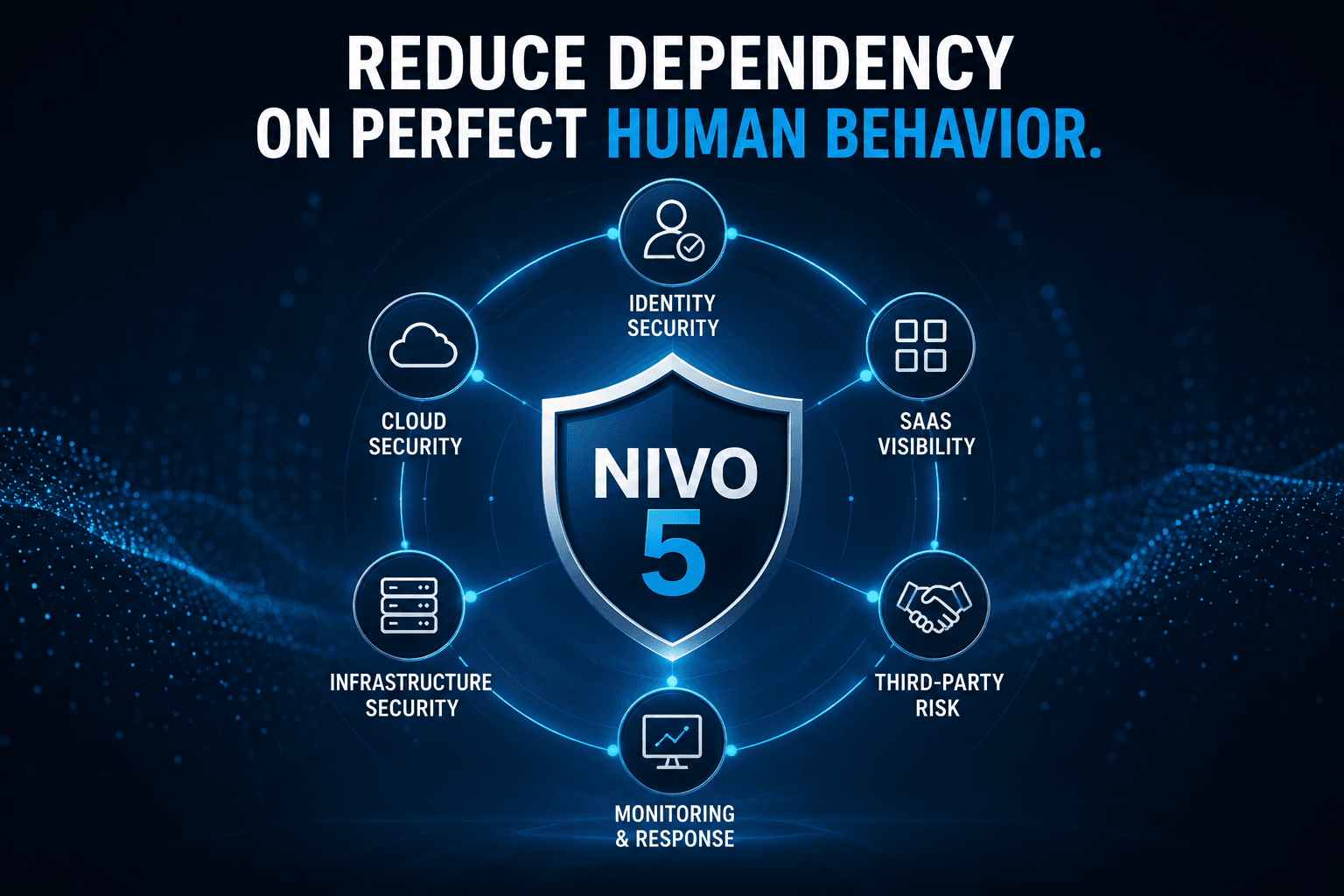
The Nivo 5 Approach
At Nivo 5, our approach is based on a simple principle:
The less an organization's security depends on perfect human behavior, the stronger its security posture becomes.
Rather than treating employees as the primary security control, we focus on identifying and reducing the technical conditions that allow mistakes to become incidents.
That means examining areas such as:
- Public-facing attack surface exposure
- Cloud and SaaS visibility gaps
- Identity and access management
- Third-party and vendor risk
- Infrastructure resilience
- Security control effectiveness
- Operational continuity risks
- Technology governance gaps
When organizations experience a breach, the root cause is rarely that someone clicked a link.
More often, the real issue is that the environment lacked the visibility, controls, governance, monitoring, or containment mechanisms necessary to limit the impact of that action.
A user making a mistake should not result in a business disruption.
If a single click can compromise critical systems, expose sensitive data, or interrupt operations, the problem is rarely the click itself.
It is the environment that allowed the click to become a crisis.
Security awareness remains important. Employees should know how to recognize suspicious activity and report potential threats.
However, awareness is not cybersecurity.
Cybersecurity is the ongoing process of designing, managing, monitoring, and securing the technology ecosystem that supports the business.
Employees should focus on serving customers, supporting operations, and growing the organization.
IT and security teams should focus on reducing cyber risk.
That is where accountability belongs.